| Focus | Academic study and historical preservation |
| Origin | Scholarly pursuit of architects, historians, and urban planners |
| Timeline | Late 19th century to present |
| Relationship with Authorities | Cooperative, with explorers working closely with authorities and property owners |
| Compared to Contemporary Urbex | More public and officially sanctioned, with a stronger emphasis on research and preservation over thrill-seeking |
Urban exploration, or "urbex" for short, refers to the act of investigating, documenting, and preserving abandoned, forgotten, or off-limits urban environments. In this timeline, urbex developed quite differently than the clandestine, risk-taking hobby it is known as in the present day.
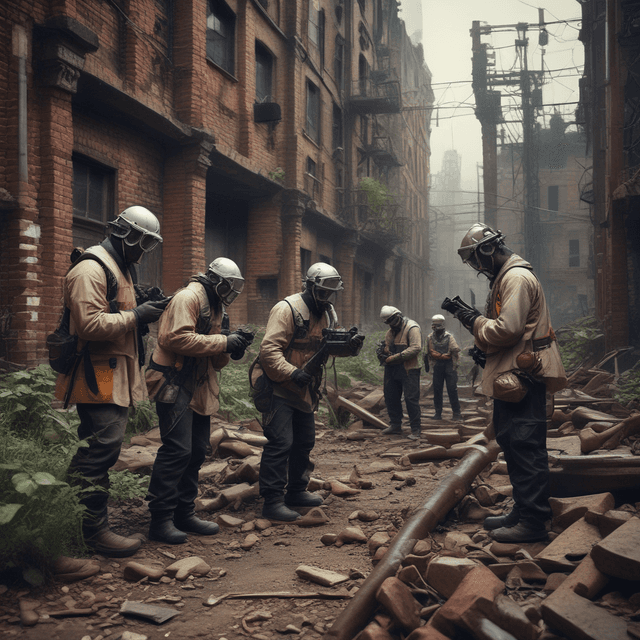
The origins of urbex can be traced back to the late 19th century, when architects, historians, and urban planners began systematically studying neglected or decaying structures in major cities. These early "urban explorers" were motivated by a scholarly interest in architectural history, urban planning, and the sociological impacts of industrialization and urbanization.
Notable pioneers of this proto-urbex movement include:
These early urban explorers worked closely with municipal authorities, property owners, and preservation societies to gain access to their subjects of study. Their findings were published in academic journals and used to inform urban renewal and historic conservation efforts.
Over the late 19th and early 20th centuries, urban exploration gradually transitioned from an elite, academic pursuit to a more accessible and widespread hobby. As growing public interest in industrial archaeology, urban renewal, and historic preservation took hold, more people began exploring abandoned factories, warehouses, hospitals, theaters, and other forgotten spaces.
During this period, urban explorers developed a range of specialized skills and techniques:
Urbex also began to attract media attention, with publications like The Urban Explorer's Gazette and Urbex Illustrated reporting on notable explorations and spreading awareness of the movement.
By the mid-20th century, urban exploration had become an established, if still somewhat niche, cultural phenomenon. Many city governments and private landowners welcomed the involvement of urbex groups, recognizing the value of their research and preservation efforts. Urbex teams were even sometimes granted special access to conduct studies and restoration work on abandoned sites slated for redevelopment.
This "golden age" of urbex saw the emergence of prominent explorer collectives like the London Urban History Society, the New York City Urbex League, and the Paris Institute of Industrial Archaeology. These organizations not only coordinated explorations but also lobbied for policies to protect historic structures, secured grants for restoration projects, and published comprehensive catalogs of a city's forgotten spaces.
While urbex remains an active pursuit today, it has evolved somewhat from its earlier, more academic roots. Technological advances like drones and 3D scanning have enabled explorers to document sites with unprecedented detail. And the rise of online communities and social media has allowed the hobby to reach a wider audience, with explorers sharing their findings and inspiring new generations.
Yet, the core mission of urbex - to study, preserve, and raise awareness of the overlooked corners of the urban environment - endures. Many contemporary urbex groups maintain close ties to local historical societies, preservation trusts, and city planning offices. And at its best, modern urbex continues to blend scientific rigor, artistic expression, and civic-minded curiosity about the hidden histories that shape our cities.
As urban landscapes continue to transform, the need for urbex's unique blend of exploration, documentation, and advocacy only grows. The legacy of the 19th century pioneers lives on in the explorers who seek to uncover, understand, and protect the architectural and cultural heritage that can still be found, if one knows where to look.
